Last Updated: October 2026
A four-year college degree can be useful for many technology careers, but it is not the only way to build job-ready skills.
For people who want to enter IT, cybersecurity, networking, cloud computing, or systems administration without committing to a traditional four-year degree, industry credentials can provide a structured way to learn specific technical skills and demonstrate them to employers.
The important distinction is that a certification or professional certificate is not a substitute for every degree requirement. Some employers and occupations still prefer or require a bachelor’s degree, particularly for certain analyst, engineering, management, and government positions. A credential can strengthen a candidate’s profile, but it does not guarantee employment, salary, interviews, or career advancement.
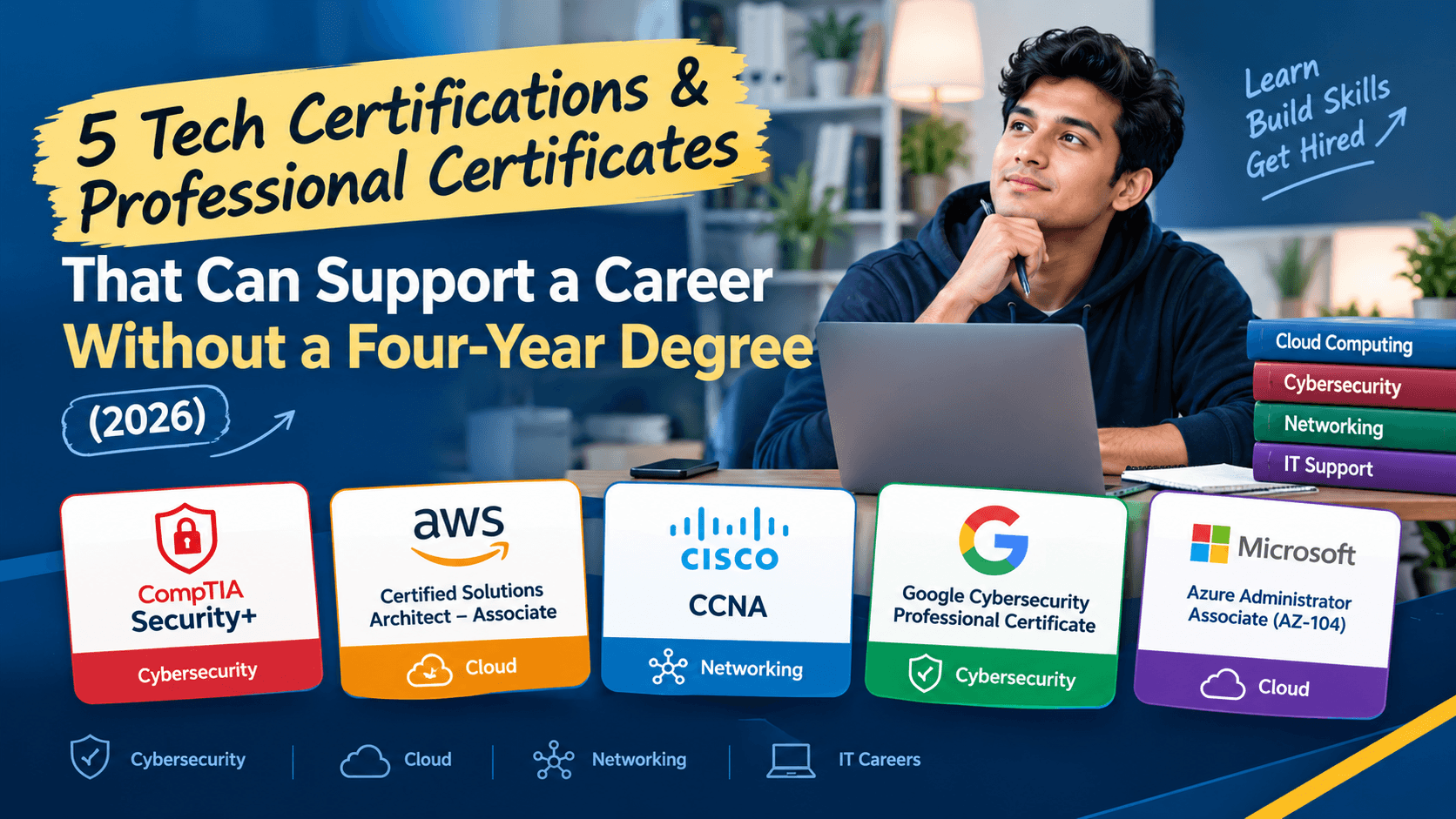
This guide covers five credentials that can support different technology career paths:
- CompTIA Security+
- AWS Certified Solutions Architect – Associate
- Cisco Certified Network Associate (CCNA)
- Google Cybersecurity Professional Certificate
- Microsoft Certified: Azure Administrator Associate (AZ-104)
One terminology point matters: the Google Cybersecurity Professional Certificate is a professional certificate, while Security+, AWS Solutions Architect – Associate, CCNA, and AZ-104 are professional certifications. They are useful credentials, but they are not identical types of qualifications.
Important: Pricing, exam formats, renewal rules, and program details can change. The figures and credential information in this article reflect information available in 2026. Always verify the current details with the issuing organization before paying for an exam or course.
Quick Comparison: 5 Tech Credentials to Consider
| Credential | Main Area | Typical Use | Current Listed Cost* |
|---|---|---|---|
| CompTIA Security+ | Cybersecurity | Entry-level security and IT roles | Varies by region |
| AWS Certified Solutions Architect – Associate | Cloud | AWS/cloud infrastructure | $150 USD |
| Cisco CCNA | Networking | Networking and infrastructure | $300 USD |
| Google Cybersecurity Professional Certificate | Cybersecurity | Beginner security learning | $49/month in U.S./Canada after trial |
| Microsoft Azure Administrator Associate (AZ-104) | Cloud administration | Azure infrastructure and administration | $165 USD in the U.S. |
*Prices can vary by country, taxes, promotions, or exam-provider arrangements. The Google figure refers to Coursera’s U.S./Canada subscription pricing.
The credentials are not ranked from best to worst. The right choice depends on the type of technology work you want to pursue and the skills you are prepared to build alongside the credential.
1. CompTIA Security+
Best suited to: People interested in cybersecurity, security operations, IT support, and foundational security concepts.
CompTIA Security+ is a widely used entry-level cybersecurity certification. It is designed to validate foundational knowledge in areas such as threats and vulnerabilities, security architecture, security operations, identity and access management, risk management, and incident response.
For someone starting without a four-year degree, Security+ can be useful because it gives a structured framework for learning security concepts rather than requiring the learner to build a curriculum from scratch.
However, earning Security+ does not automatically qualify someone for a cybersecurity job. Employers may also look for hands-on experience, networking knowledge, operating-system skills, cloud familiarity, scripting, or previous IT experience depending on the position.
What You Can Learn
A Security+ preparation path can help you understand topics such as:
- Common cybersecurity threats and vulnerabilities
- Network and application security concepts
- Identity and access management
- Security operations
- Incident response
- Risk management
- Governance and compliance concepts
- Security architecture
- Cryptographic and data-protection concepts
How to Make Security+ More Useful
A certificate alone is usually less convincing than a credential combined with evidence that you can actually use the underlying skills.
For example, a beginner could build a small home lab, document basic security configurations, practice log analysis, learn Linux fundamentals, and create a few short security projects.
That combination gives you something concrete to discuss when applying for entry-level IT or security-related positions.
Who Should Consider It?
Security+ may make sense if your longer-term goal involves:
- Security operations
- IT support with a security focus
- Junior cybersecurity roles
- Network security fundamentals
- Security administration
- Further cybersecurity study
If you have no IT background at all, learning basic networking and operating-system concepts first can make the Security+ material easier to understand.
2. AWS Certified Solutions Architect – Associate
Best suited to: People interested in cloud computing, AWS infrastructure, and cloud architecture.
The AWS Certified Solutions Architect – Associate certification focuses on designing solutions using AWS services. It is an associate-level certification and is particularly relevant to people who want to understand how cloud infrastructure is structured and operated.
AWS currently lists the exam at 65 questions, with 130 minutes of testing time. The listed exam price is $150 USD, although AWS notes that pricing can vary by location and currency.
What the Certification Covers
Preparation generally involves learning how AWS services fit together to build reliable and secure cloud environments.
Important areas include:
- AWS compute services
- Storage
- Networking
- Identity and access management
- Databases
- Security
- Reliability
- Cost considerations
- Designing scalable cloud architectures
The goal is not simply memorizing service names. You need to understand why a particular cloud architecture would be appropriate for a given requirement.
Do You Need a Degree?
AWS certification itself does not require a four-year degree.
That does not mean every cloud job is degree-free. Employers set their own requirements, and some cloud engineering, architecture, or senior infrastructure positions may prefer or require a bachelor’s degree or substantial professional experience.
For someone without a degree, a practical portfolio can therefore be particularly valuable.
For example, you could document a small AWS project showing how you:
- Deploy an application.
- Configure appropriate access controls.
- Store data securely.
- Monitor resources.
- Explain your architecture and cost decisions.
That project gives an employer something more concrete to evaluate than a certification badge alone.
Who Should Consider AWS Solutions Architect – Associate?
This credential can be a reasonable option for learners interested in:
- Cloud support
- Cloud infrastructure
- AWS administration
- Cloud engineering
- Solutions architecture
- DevOps-related environments
If cloud computing interests you but networking and Linux are completely unfamiliar, learn those fundamentals alongside your AWS preparation.
3. Cisco Certified Network Associate (CCNA)
Best suited to: People interested in networking, infrastructure, technical support, and network administration.
The Cisco Certified Network Associate (CCNA) is a networking certification covering foundational networking concepts and practical knowledge.
Cisco’s current 200-301 CCNA exam is 120 minutes and costs $300 USD. Cisco lists no formal prerequisites and states that the certification is valid for three years.
What Does CCNA Cover?
The current exam covers areas including:
- Network fundamentals
- Network access
- IP connectivity
- IP services
- Security fundamentals
- Automation and programmability
These subjects form an important foundation for understanding how devices and systems communicate across networks.
Why Networking Knowledge Still Matters
Even when an organization uses cloud services, networking concepts remain important.
Cloud environments still depend on concepts such as:
- IP addressing
- Routing
- DNS
- Network segmentation
- Access controls
- Connectivity
- Troubleshooting
That makes networking knowledge useful beyond traditional on-premises network administration.
How to Build Experience Alongside CCNA
A learner can create practical networking experience through labs and simulations.
You might practice:
- Creating VLANs
- Configuring routing
- Troubleshooting connectivity
- Working with IP addressing
- Configuring access controls
- Understanding common network failures
The objective is not to collect configuration commands. You want to understand what the commands accomplish and how to troubleshoot when something goes wrong.
Who Should Consider CCNA?
CCNA may be worth considering if you are interested in:
- Network support
- Network administration
- IT infrastructure
- Technical support
- Network security
- Cloud networking
It can also provide useful networking fundamentals for people who later move toward cloud or cybersecurity work.
4. Google Cybersecurity Professional Certificate
Best suited to: Complete beginners who want a structured introduction to cybersecurity.
The Google Cybersecurity Professional Certificate is different from the vendor certifications discussed above.
It is a professional certificate program delivered through Coursera, rather than a traditional proctored certification exam such as CCNA or AWS Solutions Architect – Associate.
Google’s current program is a nine-course series aimed at beginners. Coursera lists it as requiring no prior experience and estimates approximately six months at seven hours per week. In the U.S. and Canada, Coursera currently lists pricing at $49 per month after a seven-day trial, with most learners able to complete the program for less than $300 when following the stated part-time pace.
What You Learn
The program covers practical cybersecurity foundations, including topics such as:
- Cybersecurity fundamentals
- Common security risks
- Threats and vulnerabilities
- Security controls
- Linux
- SQL
- Python
- Security information and event management (SIEM)
- Intrusion detection
- Security operations concepts
The program is designed to help beginners develop foundational knowledge without requiring previous cybersecurity experience.
How It Differs From Security+
The Google certificate and CompTIA Security+ should not be treated as identical credentials.
The Google program is primarily a structured learning program that culminates in a professional certificate.
Security+ is an industry certification earned by passing CompTIA’s certification exam.
Interestingly, Coursera states that graduates of the Google Cybersecurity Professional Certificate can access CompTIA Security+ exam and training at a discounted price.
That means a learner could potentially use the Google program to establish foundational knowledge and then decide whether pursuing Security+ makes sense for their goals.
Who Should Consider It?
This program may be useful for someone who:
- Has no cybersecurity background
- Wants a structured starting point
- Wants to learn basic security tools and concepts
- Wants to explore cybersecurity before paying for a professional certification exam
- Plans to continue into Security+ or additional technical training
As with other credentials, completing the certificate does not guarantee a cybersecurity job. Building projects and practical experience can make the learning more useful in an actual job search.
5. Microsoft Certified: Azure Administrator Associate (AZ-104)
Best suited to: People interested in cloud administration and Microsoft Azure.
Microsoft’s Azure Administrator Associate certification is built around administering Microsoft Azure environments.
The current AZ-104 exam covers areas including:
- Azure identities and governance
- Storage
- Compute resources
- Virtual networking
- Monitoring and maintaining Azure resources
Microsoft currently lists the exam at $165 USD in the United States, with pricing based on the country or region where the exam is proctored.
What Skills Does AZ-104 Cover?
Microsoft’s current study guide expects candidates to understand areas such as:
- Microsoft Entra ID
- Azure subscriptions and governance
- Azure Storage
- Virtual machines
- Containers
- App Service
- Virtual networks
- Network security groups
- Azure Monitor
- Backup and recovery
Microsoft also recommends hands-on experience and familiarity with operating systems, networking, servers, virtualization, PowerShell, Azure CLI, the Azure portal, and related Azure management technologies.
This is important because AZ-104 is not simply a beginner course about what cloud computing means. It is aimed at people who need to administer Azure environments.
Certification Renewal
Microsoft role-based certifications such as AZ-104 expire after one year.
Microsoft states that eligible associate, expert, and specialty certifications can be renewed for free by passing the corresponding online renewal assessment on Microsoft Learn during the six-month renewal window before expiration.
That ongoing renewal requirement is something to consider before choosing the certification.
Who Should Consider AZ-104?
AZ-104 can fit learners interested in:
- Azure administration
- Cloud infrastructure
- Cloud support
- Microsoft-based IT environments
- Systems administration
- Cloud operations
If you are completely new to IT, learning basic networking, Windows/Linux administration, and virtualization first can make the certification preparation more manageable.
How Much Can You Earn With These Credentials?
This is where it is important to avoid misleading salary claims.
A certification does not have a single salary attached to it.
The U.S. Bureau of Labor Statistics publishes wage data by occupation, not by individual certification. The figures below therefore provide context for occupations that can overlap with the skills covered by these credentials. They should not be interpreted as the salary of a Security+, CCNA, AWS, Google Cybersecurity, or AZ-104 holder.
For May 2025, BLS reported national median annual wages of:
- Information Security Analysts: $129,180
- Computer Systems Analysts: $105,850
- Network and Computer Systems Administrators: $99,130
- Computer User Support Specialists: $61,860
These are occupation-level figures covering workers with different backgrounds, experience levels, employers, and locations.
For example, BLS projects employment for information security analysts to grow 21% from 2025 to 2035, while computer systems analyst employment is projected to grow 8% during the same period. Network and computer systems administrator employment is projected to decline 4%, although BLS still projects about 13,400 openings per year on average, largely because of replacement needs.
The practical lesson is simple: do not choose a certification based only on a salary number.
Your location, experience, technical skills, employer, job title, industry, and ability to demonstrate practical knowledge can all affect what you earn.
Can You Really Build a Tech Career Without a Four-Year Degree?
Yes, some technology careers can be entered without a four-year degree, but the answer depends heavily on the specific role and employer.
Some IT support, networking, cloud support, cybersecurity, and technical operations positions may accept candidates based on a combination of certifications, skills, experience, and practical projects.
Other positions commonly list a bachelor’s degree as the typical education requirement.
For example, BLS lists a bachelor’s degree as the typical entry-level education for information security analysts and computer systems analysts.
That distinction matters.
A certification can demonstrate that you have studied a particular technical subject. It does not automatically remove an employer’s education requirement.
A Better Way to Evaluate a Career Path
Before investing money in a certification, search current job postings for the type of role you want.
Review around 20–30 relevant postings and record:
- Whether a degree is required or preferred
- Which certifications appear repeatedly
- Which technical skills are requested
- Whether experience is required
- Which tools employers mention
- Whether entry-level positions are actually available in your target location
This gives you a much better picture of what employers are asking for than a generic list of “best certifications.”
A Practical Six-Month Roadmap
If you are starting from zero, you do not need to collect several credentials at once.
A focused six-month plan can look like this:
Month 1: Choose One Career Direction
Decide whether you are primarily interested in:
- Cybersecurity
- Cloud
- Networking
- IT support
- Systems administration
Do not start with five certifications simultaneously.
Month 2: Build the Fundamentals
Learn the basics relevant to your chosen path.
For cybersecurity, that could mean networking, Linux, authentication, and common security concepts.
For cloud, learn networking, operating systems, virtualization, and basic cloud architecture.
For networking, focus on IP addressing, routing, switching, DNS, and troubleshooting.
Month 3: Start Your Credential
Choose one credential that matches your target role.
Follow the official exam objectives or course curriculum rather than relying only on random videos.
Month 4: Build a Practical Project
This is one of the most important steps.
Create something you can show or explain.
Examples include:
- A small AWS environment
- An Azure administration lab
- A network configuration lab
- A Linux security project
- A basic SIEM/log-analysis exercise
- A documented troubleshooting project
Keep notes about what you built, why you built it, and what problems you solved.
Month 5: Finish the Credential and Improve Your Portfolio
Complete the course or prepare for the certification exam.
At the same time, turn your project notes into concise portfolio documentation.
A good project description should explain:
Problem → Tools → Process → Result → What You Learned
Month 6: Begin Applying and Keep Learning
Update your résumé and LinkedIn profile with the credential, relevant technical skills, and projects.
Then begin applying for positions that genuinely match your current experience.
Do not wait until you have every possible certification.
How to Build an ATS-Friendly Tech Résumé
An applicant tracking system (ATS) is software employers may use to organize and screen applications.
A certification does not “bypass” an ATS.
Instead, your résumé should make your actual qualifications easy to identify.
Include the Full Credential Name
Instead of writing only:
Security+
use:
CompTIA Security+
For other credentials, use the official name where practical.
Put Certifications in Their Own Section
For example:
Certifications
- CompTIA Security+
- Cisco Certified Network Associate (CCNA)
- AWS Certified Solutions Architect – Associate
Only list credentials you have actually earned.
Match Skills to the Job Description
If the job legitimately requires skills you possess, use the employer’s terminology where appropriate.
For example, if you actually have experience with:
- Linux
- TCP/IP
- AWS
- Azure
- Python
- SQL
- SIEM
- Active Directory
make those skills visible rather than hiding them inside long paragraphs.
Show Projects
For someone without a four-year degree or extensive professional experience, projects can provide useful evidence of technical ability.
Instead of writing:
“Interested in cybersecurity.”
write something more concrete, such as:
“Built a home security lab to analyze authentication and system logs and documented the investigation process.”
The second statement gives the reader something specific to evaluate.
Common Mistakes to Avoid
1. Collecting Certifications Without Building Skills
Five badges do not automatically equal five times the value.
It is usually more useful to understand one technical area well and demonstrate that knowledge through projects than to collect unrelated credentials.
2. Choosing a Credential Only Because Someone Promised a High Salary
Salary figures are often presented without explaining occupation, location, experience, or source.
Always check what the number actually represents.
3. Assuming a Certification Replaces Every Degree Requirement
It does not.
Some employers explicitly require a bachelor’s degree. Others may be more flexible.
Read actual job descriptions before making a career decision.
4. Ignoring Hands-On Practice
Cloud, networking, cybersecurity, and systems administration are practical fields.
Knowing definitions is different from being able to configure, troubleshoot, document, and explain a real environment.
5. Ignoring Renewal Requirements
Some certifications expire and require renewal.
Microsoft role-based certifications such as AZ-104 require annual renewal, while Cisco states that CCNA is valid for three years.
Check the current rules before investing.
6. Paying Before Checking the Official Provider
Certification prices and course subscriptions can change.
Before paying, verify the current price, exam version, eligibility rules, renewal policy, and delivery method on the provider’s official website.
Which Credential Makes Sense for a Beginner?
There is no single correct starting point for everyone.
| If Your Main Interest Is… | Credential to Explore | Why It May Fit |
|---|---|---|
| Cybersecurity fundamentals | Google Cybersecurity Professional Certificate | Beginner-friendly structured learning |
| Entry-level security knowledge | CompTIA Security+ | Broad cybersecurity foundation |
| Cloud computing | AWS Solutions Architect – Associate | AWS architecture and cloud concepts |
| Networking | Cisco CCNA | Strong networking fundamentals |
| Microsoft cloud administration | Azure Administrator Associate (AZ-104) | Azure administration skills |
This is a directional guide, not a ranking.
Your existing knowledge should influence the decision.
For example, a person with networking experience may be better prepared for a cloud certification than someone who has never worked with IP addresses or operating systems.
Frequently Asked Questions
Can I get a tech job without a four-year degree?
Yes, some technology roles can be entered without a bachelor’s degree, but requirements vary by employer and occupation.
Certifications, practical projects, technical skills, and experience can strengthen an application, while some positions still require or strongly prefer a degree.
Which tech certification is easiest for a beginner?
There is no universal “easiest” certification because difficulty depends on your previous knowledge.
A complete beginner may find a structured professional certificate easier to start with than an associate-level professional certification exam.
Is the Google Cybersecurity Professional Certificate the same as Security+?
No.
The Google Cybersecurity Professional Certificate is a professional certificate program delivered through Coursera. CompTIA Security+ is a professional certification earned by passing a CompTIA certification exam.
The Google program can help prepare learners for Security+, and Coursera currently offers graduates access to discounted Security+ exam and training options.
Is AWS Solutions Architect – Associate worth considering without a degree?
The certification itself does not require a four-year degree.
However, employers determine their own job requirements. Some cloud roles may accept candidates based on technical skills and experience, while others may request a bachelor’s degree.
Hands-on AWS projects can help demonstrate what you actually know.
Is CCNA useful outside Cisco networking?
Yes. Although the certification is Cisco-specific, many of the underlying networking concepts—such as IP connectivity, network access, security fundamentals, and troubleshooting—are broadly relevant to IT infrastructure.
Does AZ-104 expire?
Yes.
Microsoft role-based certifications such as Azure Administrator Associate expire after one year. Eligible certifications can be renewed at no cost by passing the online renewal assessment during the applicable renewal window.
Can a certification guarantee a six-figure technology salary?
No.
Certification providers do not guarantee a particular salary, and occupation-level wage statistics are not certification-specific.
Your salary can depend on location, experience, employer, role, technical skills, education, and other factors.
Should I get several certifications at once?
Usually, it is more practical to build one coherent skill path first.
For example, someone pursuing cybersecurity could start with foundational security and networking knowledge, earn one relevant credential, build practical projects, and then decide whether another certification would add value.
Final Takeaway
A four-year degree can be valuable, but it is not the only way to develop technology skills.
Credentials such as CompTIA Security+, AWS Certified Solutions Architect – Associate, CCNA, Google Cybersecurity Professional Certificate, and Microsoft Azure Administrator Associate can provide structured learning and a way to demonstrate knowledge in specific areas.
The credential itself, however, is only one part of the picture.
A stronger approach is to combine:
- One relevant credential
- Practical technical skills
- Hands-on projects
- A clear résumé
- Evidence of what you can actually do
- A realistic understanding of employer requirements
- Continued learning as technology changes
Before paying for any certification, look at current job postings for the role you want, verify the credential’s current requirements and price, and determine whether employers in your target market actually value it.
Building a technology career this way may take time, but it provides a more realistic path than relying on a single certification to create immediate career or salary outcomes.
Sources and Verification
The key factual and current information in this article was checked against official or primary sources, including:
- U.S. Bureau of Labor Statistics (BLS), Occupational Outlook Handbook and employment projections
- AWS Certification — AWS Certified Solutions Architect – Associate
- Cisco — CCNA / 200-301 CCNA
- CompTIA — Security+
- Coursera / Google Career Certificates — Google Cybersecurity Professional Certificate
- Microsoft Learn — Azure Administrator Associate and AZ-104
- Microsoft Learn — Certification Renewal FAQ
Disclaimer: This article is for general educational and informational purposes. Certification requirements, pricing, exam versions, renewal policies, employer requirements, and labor-market conditions can change. A certification or professional certificate does not guarantee employment, interviews, salary, promotion, admission, or any other specific outcome. Verify current credential and job requirements with the issuing organization and prospective employer before making a financial or career decision.