
Receiving an acceptance letter from an international university is an exciting milestone, but navigating the visa application process requires equally thorough preparation. Among all the criteria assessed by immigration departments, understanding the student visa proof of funds requirements 2026 is often where applicants encounter the most questions.
Immigration authorities need clear evidence that you can comfortably cover your tuition fees, everyday living costs, and travel expenses without facing financial distress or relying on unauthorized employment. While universities outline general living expense estimates, consular officers review your financial documents to confirm that the funds are genuine, accessible, and supported by a legitimate history.
Here is a practical, country-by-country breakdown of how financial capacity is assessed in the United States, Canada, the United Kingdom, Australia, and Germany, along with the key documentation rules you need to know.
What Visa Officers Evaluate in Your Financial Profile
Rather than just looking at the closing figure on a bank statement, consular officers look at the broader context of an applicant’s financial situation:
- Accessibility of Funds: Living expenses must generally be proven using liquid capital—funds that can be accessed without severe restrictions or delayed liquidation periods.
- Legitimate Source of Capital: If an account receives a substantial deposit, authorities expect to see the background behind that money (such as salary savings, business revenue, documented property transactions, or bank loans).
- Country-Specific Holding Rules: Certain countries enforce strict holding periods (for example, the UK’s exact 28-day requirement), whereas other destinations review overall account stability and transaction patterns over time.
- Exchange Rate Margin: Exchange rates change continuously. If your home currency drops against the destination currency before your visa decision, an account without an extra cushion could risk falling below the minimum target. Planning with a reasonable safety margin is good practice.
2026 Financial Requirements Matrix by Country
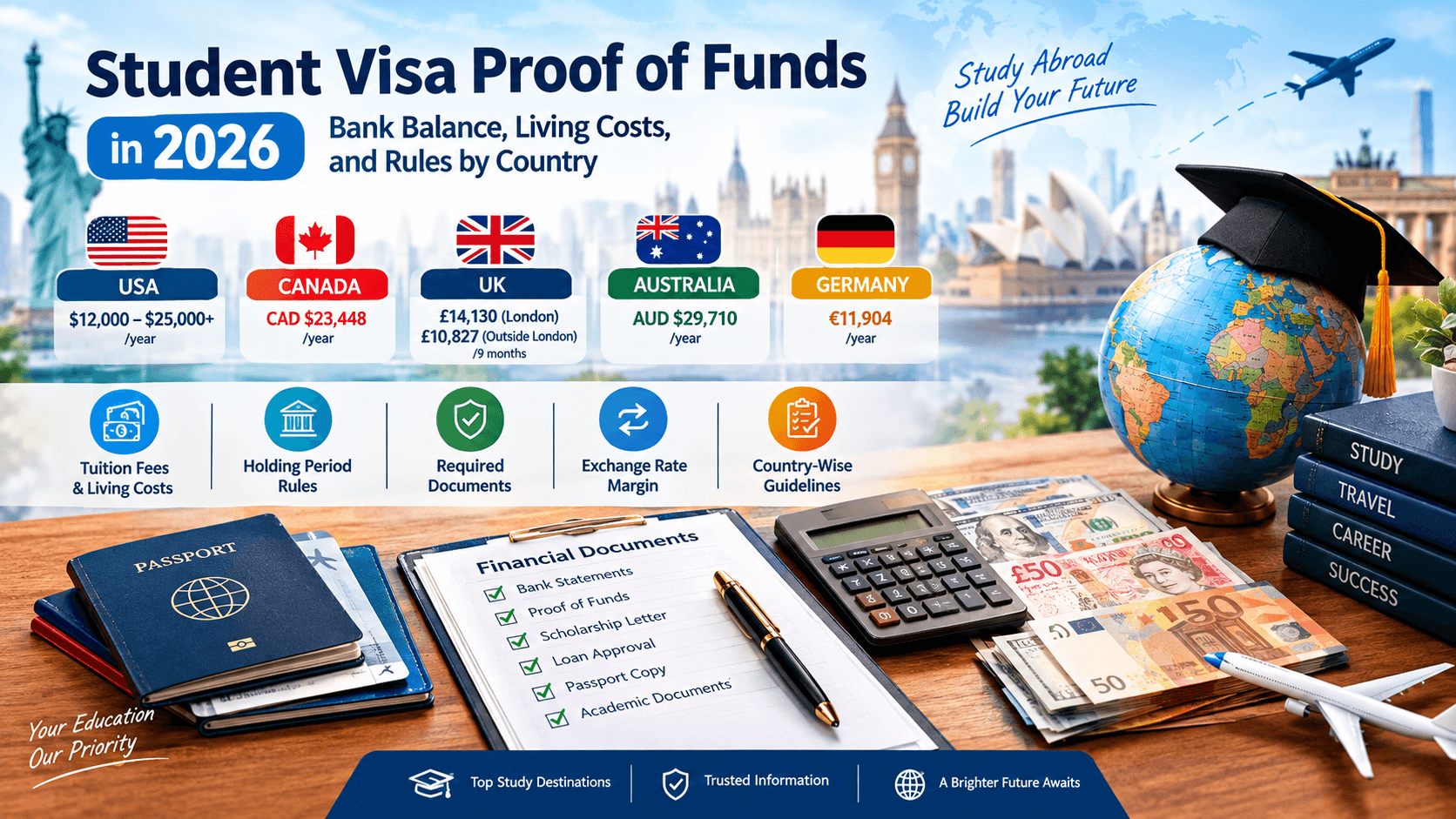
The following table provides a direct comparison of base requirements, living expense benchmarks, and primary verification methods across five major study destinations:
| Country | What You Must Demonstrate | Statutory Living Cost Benchmark | Holding Period Rule | Primary Financial Evidence |
| United States | First-year tuition + full living expenses on Form I-20 | University-specific ($12,000 to $25,000+/year) | Evaluated on stability and source | Personal/sponsor bank statements, loan sanction letters, scholarship letters |
| Canada | First-year tuition + official living allowance | CAD $23,448 (Single applicant, outside Quebec) | Evaluated on overall transaction trail | Guaranteed Investment Certificate (GIC) + bank statements |
| United Kingdom | Unpaid first-year tuition + up to 9 months of maintenance | £14,130 (London: £1,570/mo) / £10,827 (Outside London: £1,203/mo) | Strictly 28 consecutive days | Bank statements, passbooks, or government-approved loan letters |
| Australia | First-year tuition + 12 months living costs + actual travel costs | AUD $29,710 (Primary applicant baseline) | Demonstrated genuine access | Bank deposits, approved educational loans, or verifiable annual family income |
| Germany | Proof of annual living subsistence | €11,904 per year (€992 per month) | No universal holding period; proof of sufficient funds required | Blocked account (Sperrkonto), recognized scholarship, or Declaration of Commitment |
Detailed Country Guidelines for International Students
1. Canada: The IRCC Living Standard and Proof of Financial Support
Immigration, Refugees and Citizenship Canada (IRCC) sets minimum financial support requirements that are updated periodically based on government-established living-cost benchmarks.
- Base Living Allowance: Single students pursuing studies outside Quebec must show CAD $23,448 for basic living costs, in addition to their first-year tuition.
- The GIC Route: Some international students may use a Guaranteed Investment Certificate (GIC) from a qualifying Canadian financial institution as part of their financial documentation, where applicable. The funds are held with the financial institution and are generally released according to the terms of the GIC program after the student arrives in Canada.
- Tuition and Additional Costs: If you have not prepaid your tuition in advance, immigration officers will check that your bank statements or sponsor records clearly demonstrate sufficient funds to pay the outstanding balance alongside living allowances. While there is no universal law mandating a specific 6-month hold, presenting a clear multi-month transaction ledger demonstrates financial stability.
2. United Kingdom: Appendix Finance and the 28-Day Holding Rule
UK Visas and Immigration (UKVI) operates a rule-based system detailed in Appendix Finance of the UK Immigration Rules.
- Updated Maintenance Benchmarks:
- Studying in London: £1,570 per month for up to 9 months (Total: £14,130).
- Studying outside London: £1,203 per month for up to 9 months (Total: £10,827).
- The Strict 28-Day Requirement: The total amount required (unpaid tuition stated on your Confirmation of Acceptance for Studies [CAS] plus your full maintenance requirement) must be held in the account without dropping below the minimum threshold for 28 consecutive days.
- Date of Evidence: The end date of the 28-day period must be within 31 days of the date you formally submit and pay for your online visa application.
- Deduction for University Accommodation: If you have prepaid fees directly to your educational institution for university-managed accommodation, you can deduct that amount from your living expense total, up to a maximum deduction of £1,570.
3. Germany: Recognized Pathways for Financial Verification
Because tuition fees at public universities across Germany are typically nominal or non-existent, consular assessment focuses primarily on living expenses.
- Annual Benchmark: The standard living-funds benchmark for 2026 is €11,904 for a 12-month period, equivalent to €992 per month.
- Accepted Financial Evidence: While a federally recognized Blocked Account (Sperrkonto) (provided by services such as Expatrio, Coracle, or Fintiba) is a standard route, German missions also accept other verified means, including:
- An official award letter from a recognized public scholarship provider (such as the DAAD or Erasmus+).
- A formal Declaration of Commitment (Verpflichtungserklärung) issued by a resident in Germany through a local foreigners authority (Ausländerbehörde).
- Private University Students: If matriculating into a private university that charges tuition, you must document living expenses and provide evidence that program fees are covered.
4. United States: Form I-20 Compliance and Consular Review
For a US F-1 student visa, the estimated cost of attendance is listed on Form I-20 by the student’s school and is used as an important reference when assessing financial ability.
- First-Year Funding: The consular officer will expect to see immediate liquid funds that equal or exceed the total estimated expenses on Form I-20 (tuition, estimated living expenses, health coverage, and books).
- Multi-Year Studies: For longer degree programs, students are not required to hold cash for all four years in a single bank account upfront. However, applicants should present realistic evidence of ongoing family income, professional earnings, or stable investments showing how subsequent years will be funded. (If your family is reviewing financing options, explore our guide on Student Loans for practical repayment strategies).
- Documentation Standards: Consular officers look for reliable evidence such as bank statements, scholarship letters, or sanctioned loan agreements. Officers may also request supplementary documentation, such as parental employment verification or recent tax documents, to confirm the consistency of family earnings.
5. Australia: Subclass 500 Financial Capacity Assessments
The Australian Department of Home Affairs requires student visa applicants to prove they can cover course fees, living costs, and associated travel expenses.
- Living Cost Benchmark: The primary applicant benchmark is set at AUD $29,710 for 12 months.
- Travel Costs: Applicants must account for actual return travel costs (flight costs based on regional departure points) along with mandatory Overseas Student Health Cover (OSHC).
- Annual Household Income Route: As an alternative to showing liquid bank savings, applicants may meet financial capacity requirements if their parents or spouse provide evidence of an annual personal taxable income of at least AUD $87,856 (or AUD $102,500 if accompanied by family), verified through official government taxation notices.
Acceptable vs. Unacceptable Asset Categories
Some asset types may be difficult for immigration authorities to treat as readily available funds, particularly when they are illiquid or difficult to verify:
Commonly Accepted Financial Sources       May Not Qualify as Primary Proof of Readily Available Funds
───────────────────────────────────       ───────────────────────────────────────────────────────────
✔ Personal savings and checking accounts  ✖ Raw commercial or agricultural land value
✔ Redeemable term/fixed deposits          ✖ Gold, jewelry, or precious metals
✔ Sanctioned educational bank loans       ✖ Restricted or difficult-to-liquidate investments
✔ Official government/institutional grants✖ Assets that cannot be readily verified or converted to usable funds
✔ Readily withdrawable provident funds    ✖ Unofficial, undocumented personal IOUs
Understanding Financial Sponsorship
Immigration departments evaluate who is paying for your studies and how clearly that relationship is documented:
- Immediate Family Sponsors (Self, Parents, Spouse): These are commonly used sponsorship arrangements because parents and spouses generally have a clear, documentable relationship with the student. Standard identification and civil records are generally sufficient to establish kinship.
- Extended Family (Grandparents, Aunts, Uncles): While accepted by many visa authorities, sponsorship by extended relatives often receives closer examination. Applicants typically need to provide an Affidavit of Support, detailed civil records showing the relationship, and a transparent explanation of why the family member is providing sponsorship.
- Third-Party Individuals or Friends: Financial support from distant acquaintances or informal third-party contacts is generally scrutinized heavily by consular staff to ensure funds are genuinely accessible to the applicant.
Handling Recent Bank Deposits
A common issue during visa processing is an unexplained, sudden credit into a bank account shortly before submitting an application. If an account with a modest balance suddenly receives a large transfer without context, visa officers may question whether the money truly belongs to the applicant.
How to Present Large Credits Transparently:
- Provide Context: If funds were deposited recently, provide clear documentation showing their legitimate source (for example, from an asset sale, maturity of a fixed deposit, or a retirement gratuity), including relevant supporting paperwork—such as a registered deed, maturity certificate, or employer statement.
- Demonstrate Routine Stability: Accounts that demonstrate steady, gradual savings or regular salary deposits naturally present fewer verification hurdles.
- Educational Loan Approvals: A formal education loan letter from a regulated commercial bank is recognized as clear evidence, as the lending institution has already conducted its own financial assessment.
Pre-Submission Financial Checklist
Before submitting your visa paperwork, review this practical checklist:
- [ ] Calculate the Complete Target: Combine your unpaid tuition, required national living allowance, travel costs, and mandatory health insurance.
- [ ] Account for Currency Movement: Plan with a sensible buffer above the statutory baseline so normal exchange rate movements do not impact your balance.
- [ ] Check Name Consistency: Ensure the account holder’s name on your bank statements matches government IDs and affidavits exactly.
- [ ] Obtain Official Bank Documentation: Ensure statements and balance confirmation certificates carry official branch stamps, authorized signatures, and verified bank contact details.
- [ ] Prepare Supporting Income Records: Keep your sponsor’s employment records, business documentation, or available tax filings organized in case additional verification is requested.
- [ ] Include a Clear Summary: If you are presenting multiple accounts or currency conversions, a concise cover sheet outlining total balances makes the file straightforward for the reviewing officer.
Frequently Asked Questions
Can property valuation certificates replace liquid cash for living costs?
No. While property deeds and valuation reports help demonstrate family wealth and ties to your home country, they cannot be spent on everyday essentials like rent and food abroad. Authorities require liquid funds to satisfy living expense rules.
What happens if a bank balance dips below the required amount in the UK?
Under the UK’s Appendix Finance, if your balance drops below the required sum for even a single day during the mandatory 28-day window, the financial requirement is not met. You would generally need to establish a new qualifying 28-day period before relying on that account balance for the application.
Can anticipated part-time work cover my proof of funds?
No. Even though many student visas allow part-time work during academic terms, immigration agencies evaluate your financial eligibility before departure. You must demonstrate sufficient existing resources without relying on future student wages.
Does paying full tuition in advance reduce my proof of funds requirement?
In countries where prepaid tuition is recognized for financial assessment, paying tuition directly to the institution can reduce the amount of tuition you need to demonstrate as outstanding. You will then only need to demonstrate the required living costs and any remaining travel expenses.
Final Thoughts
Successfully meeting student visa financial requirements comes down to clear documentation, accurate calculations, and complete transparency. International immigration frameworks in the US, UK, Canada, Australia, and Germany are structured to welcome genuine students while ensuring they can support themselves throughout their academic journeys.
Start your financial preparations early, verify current exchange rates, and keep documentation organized. For more insights on selecting accredited academic pathways, explore our detailed guides under Degrees to help plan your educational future.