
Choosing a career path used to follow a familiar pattern: complete an educational program, secure an entry-level position, and build functional expertise over time. Today, the steady integration of machine learning tools, workflow automation, and predictive software models has shifted how organizations structure operational tasks. From an editorial and industry perspective, occupations focused primarily on structured, repetitive data manipulation—such as basic bookkeeping, standard marketing copy generation, initial code debugging, and document sorting—are increasingly exposed to automation as organizations adopt AI-assisted tools and redesign routine workflows.
However, career planning in this environment is not about evading technology altogether. BLS employment projections show continued demand in several specialized technical and professional occupations, although the effects of artificial intelligence and digital tools vary by occupation and task. Occupations requiring direct physical adaptability, regulated human accountability, and context-dependent critical judgment continue to project sustained labor demand. Even among skilled trade roles where baseline wages start lower than corporate executive jobs, entering the workforce with minimal educational debt provides substantial financial resilience.
This guide provides an evidence-based assessment of career pathways demonstrating structural resilience to automation. Each career profile is benchmarked against official wage statistics, 2025–2035 employment growth projections, educational frameworks, and realistic automation boundaries.
What Makes an Occupation Resilient to Automated Replacement?
Labor economists evaluate an occupation’s automation exposure not by the industry it belongs to, but by the specific task architecture of the daily role. Automated tools excel at pattern identification across closed data environments, executing predefined code routines, and generating probabilistic summaries.
Automation encounters practical and regulatory constraints across three primary workplace domains:
| Core Resilience Dimension | Operational Reality | Why Software Automation Is Constrained |
| 1. Unstructured Physical Manipulation | Working on dynamic, non-standard physical sites (e.g., troubleshooting legacy electrical conduits, performing emergency medical triage). | Automated machinery generally requires structured, predictable physical inputs; real-world environments present unpredictable obstacles, structural wear, and spatial variability. |
| 2. Professional & Legal Liability | Formally assuming regulatory, clinical, or judicial responsibility for project outcomes and public safety. | In regulated professions, licensing rules and professional accountability can limit the extent to which software independently performs or assumes responsibility for certain tasks. Requirements vary by profession and jurisdiction. |
| 3. Contextual Negotiation & Empathy | Navigating interpersonal crises, interpreting non-verbal behavioral cues, and building trust in high-stakes negotiations. | Statistical models lack situational consciousness and genuine social reciprocity, which remain vital in clinical, judicial, and executive environments. |
Comparative Matrix: Resilient Occupations
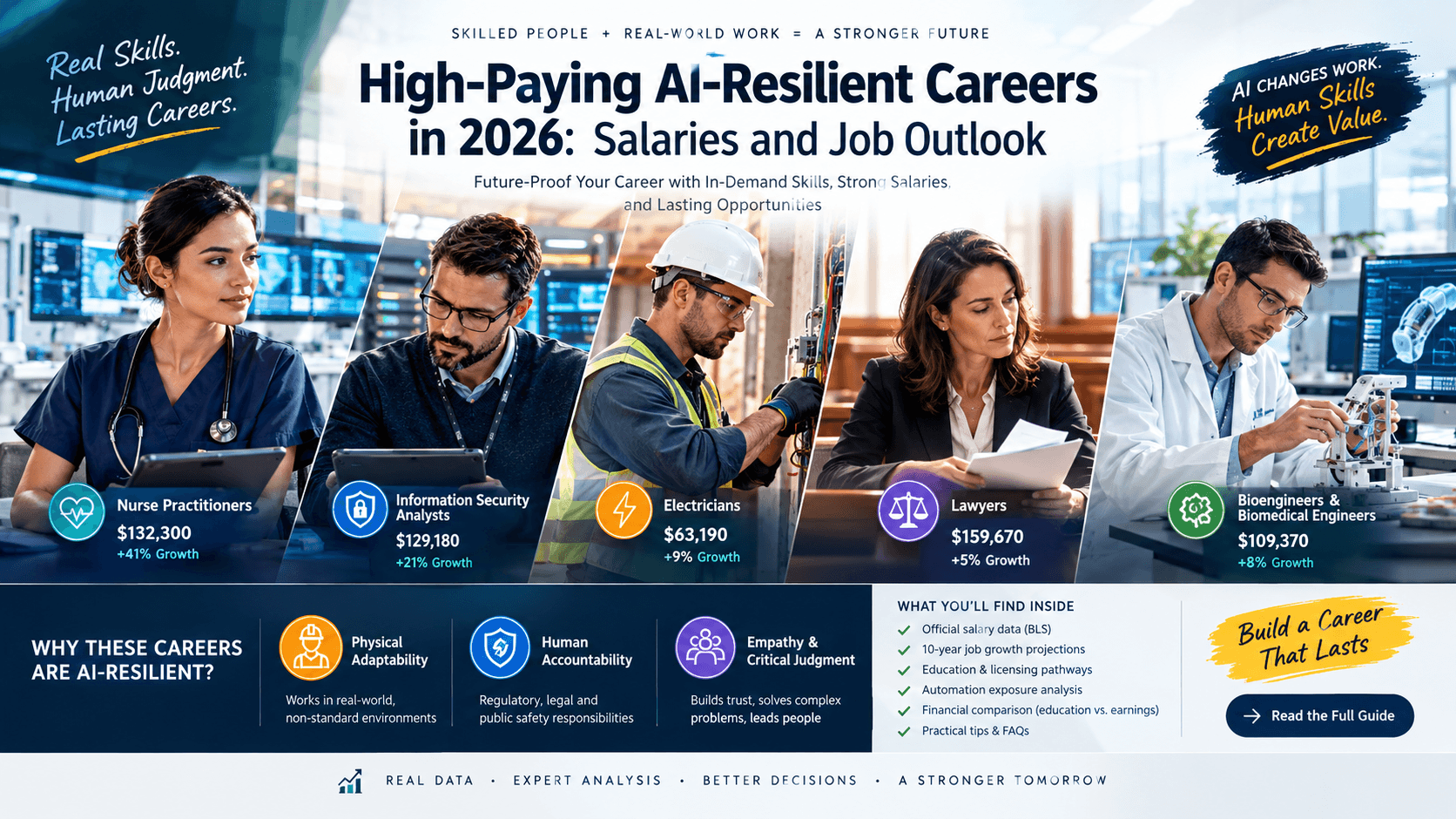
The table below summarizes median annual compensation, 10-year projected employment growth, and estimated automation exposure levels based on official data from the U.S. Bureau of Labor Statistics (BLS Occupational Outlook Handbook, 2025–2035 Projections & May 2025 Wage Releases):
| Professional Occupation (BLS Code) | Official BLS Median Annual Wage (May 2025) | BLS Projected Growth (2025–2035) & Category | Standard Education & Entry Route | Editorial Assessment of Task-Level AI Exposure* |
| Nurse Practitioners (29-1171) | $132,300 | +41% (Much faster than average) | Master of Science in Nursing (MSN) or DNP + State APRN Licensure | Low Exposure |
| Information Security Analysts (15-1212) | $129,180 | +21% (Much faster than average) | Bachelor’s Degree in CS/IT or Specialized Technical Credentials | Moderate Exposure (Routine monitoring automated; strategy remains human) |
| Electricians (47-2111) | $63,190 (Top 10%: $108,510) | +9% (Much faster than average) | 4–5 Year Apprenticeship + State/Municipal Electrical License | Low Exposure |
| Lawyers (23-1011) | $159,670 | +5% (4.7% in detailed projections; Faster than average) | Juris Doctor (JD) + State Bar Admission | Moderate Exposure (Document review automated; litigation/counsel remains human) |
| Bioengineers and Biomedical Engineers (17-2031) | $109,370 (Top 10%: $168,180) | +8% (Much faster than average) | Bachelor’s Degree in Biomedical or Mechanical Engineering | Low-to-Moderate Exposure |
*Editorial Rating Notice: The “Editorial Assessment of Task-Level AI Exposure” ratings reflect an editorial assessment based on task composability—measuring the proportion of an occupation’s daily tasks requiring physical presence, discretionary legal responsibility, and interpersonal mediation, versus tasks subject to routine algorithmic automation. These ratings represent analytical perspectives rather than official government metrics. These ratings do not measure the probability of job loss, guarantee future employment security, or imply that any occupation is immune to AI-driven changes.
*Note on BLS Growth Categories: The BLS projects total employment across all occupations to grow by 3.5% between 2025 and 2035. Growth classifications in the Occupational Outlook Handbook indicate how an occupation’s projected growth compares with the overall benchmark. Refer to the linked BLS occupation pages for the official growth category assigned to each career.
Detailed Occupational Analyses: Duties, Wages, and Educational Realities
1. Nurse Practitioners (Advanced Practice Registered Nurses)
While clinical diagnostic software can review radiological imaging and flag physiological trends from electronic health records, diagnostic delivery and bedside patient care remain fundamentally collaborative.
- Verified Compensation: According to the official BLS Nurse Practitioners Profile (SOC 29-1171, May 2025 Release), Nurse Practitioners earn an official median annual wage of $132,300. Advanced practice subfields command higher figures; for instance, Nurse Anesthetists (CRNAs, SOC 29-1151) report an official BLS median annual wage of $236,590 in May 2025 data releases.
- Projected Growth: The BLS Employment Projections project a 41% increase in employment specifically for Nurse Practitioners between 2025 and 2035, creating an estimated 137,800 net new positions.
- Why the Role Resists Complete Automation: Patient care involves physical diagnostic palpation, observing emotional cues, and managing acute psychological distress. Medical management requires evaluating clinical probabilities within the context of a patient’s personal ethics, family situation, and individual health goals.
- Licensing & Education Pathways: Candidates generally complete a Bachelor of Science in Nursing (BSN), obtain an unencumbered Registered Nurse (RN) license, and complete an accredited graduate program—either a Master of Science in Nursing (MSN) or Doctor of Nursing Practice (DNP). Exact clinical training hours, scope of practice (Full, Reduced, or Restricted Practice), and prescriptive authority vary by individual State Boards of Nursing.
2. Information Security Analysts & Advanced Cyber Roles
While machine learning platforms automate baseline log aggregation, firewall filtering, and signature-based malware detection, defending systems against coordinated human adversaries requires adaptive strategic oversight.
- Verified Compensation: The BLS Information Security Analysts Profile (SOC 15-1212, May 2025 release) reports an official median annual wage of $129,180. Advanced enterprise roles—such as enterprise Cybersecurity Architects or Directors of Information Security—often report higher market-rate compensation depending on company size, region, and total compensation packages (including bonuses or equity).
- Projected Growth: Employment is projected to grow 21% from 2025 to 2035 (Much faster than average), generating approximately 40,600 net new jobs according to the BLS. The BLS notes that increased use of artificial intelligence and cloud computing creates novel attack surfaces, driving sustained demand for specialized security personnel.
- Why the Role Resists Complete Automation: Cyber defense involves countering active human adversaries who adapt their vectors, utilize novel social engineering, and target undisclosed systemic vulnerabilities. Responding to zero-day incidents requires strategic lateral thinking, rapid containment decisions, and cross-functional leadership under operational constraints.
- Licensing & Education Pathways: Entry typically requires a Bachelor of Science in Computer Science, Cybersecurity, or Information Systems, or a validated technical background. Professionals frequently pursue vendor-neutral credentials to validate specialized competencies. (To explore practical credential roadmaps, review our detailed guide on Certifications).
3. Electricians (General, Commercial & Industrial Specializations)
Skilled trade specializations represent a notable balance between sustained workforce demand and relatively low educational debt. While entry-level and median wages are lower than corporate legal or medical roles, the low debt barrier enhances long-term financial security.
- Verified Compensation: The national median wage for general electricians (SOC 47-2111) is $63,190 per year according to the BLS Electricians Profile (May 2025 data). The highest-paid 10% of electricians earned more than $108,510 annually, according to BLS data for May 2025. Actual earnings vary by experience, specialization, location, and overtime.
- Projected Growth: The BLS projects employment for electricians to expand by 9% between 2025 and 2035 (Much faster than average), generating roughly 75,900 net new positions across a total base of 821,000 jobs. Growth is driven by electrical grid modernization, commercial electric vehicle charging systems, and industrial automation retrofitting.
- Why the Role Resists Complete Automation: Physical working environments are non-standard. While pre-fabrication tools exist, automated machinery currently cannot navigate legacy building crawlspaces, retrofit custom conduit runs through historical architecture, or safely isolate high-voltage faults on active, damaged physical sites.
- Licensing & Education Pathways: Many electrician apprenticeship programs combine classroom instruction with substantial supervised on-the-job training. The required hours, program structure, tuition arrangements, and licensing criteria vary by apprenticeship sponsor and jurisdiction. Programs are commonly structured through joint apprenticeship committees (such as Electrical Training Alliance / IBEW) or contractor associations (like IEC).
4. Lawyers (Corporate Regulatory, Compliance & Litigation)
While generative AI tools accelerate mechanical tasks—such as electronic document discovery, basic contract indexing, and statutory cross-referencing—interpretive, judicial, and negotiation responsibilities remain with human counsel.
- Verified Compensation: The BLS Lawyers Profile (SOC 23-1011, May 2025 release) reports an official median annual wage of $159,670 for licensed lawyers. Note that BLS figures cover all legal fields; specialized corporate counsel, regulatory compliance directors, and litigation partners in large enterprise practices often command higher market-rate compensation based on firm tier and client portfolio.
- Projected Growth: Employment is projected to grow by approximately 5% from 2025 to 2035 (4.7% in detailed BLS employment-projection data; classified as Faster than average), generating approximately 40,600 net new positions as documented in the BLS Occupational Outlook Handbook.
- Why the Role Resists Complete Automation: AI-assisted tools may improve the efficiency of legal research and document review, but their long-term effects on lawyer hiring, workloads, and the distribution of legal tasks remain uncertain. Courtroom representation, professional accountability, and compliance with jurisdiction-specific licensing rules remain important parts of legal practice.
- Licensing & Education Pathways: Entry requires a 4-year undergraduate degree, completion of a 3-year Juris Doctor (JD) curriculum from an accredited law school, meeting the Multistate Professional Responsibility Examination (MPRE) requirement where required by the jurisdiction, and formal admission to the state bar via the bar examination.
5. Bioengineers and Biomedical Engineers
Bridging biological sciences with mechanical, electrical, and software engineering, bioengineers and biomedical engineers design, test, and evaluate medical equipment, prosthetics, and diagnostic systems.
- Verified Compensation: The BLS Bioengineers and Biomedical Engineers Profile (SOC 17-2031, May 2025 data) reports an official median annual salary of $109,370, with the top 10% earning $168,180+ annually in specialized research and medical equipment manufacturing.
- Projected Growth: Employment is projected to grow 8% from 2025 to 2035 (Much faster than average), generating an estimated 1,800 net new positions according to BLS projections. Expansion is supported by an aging global population and the development of robotic surgical platforms, biocompatible materials, and advanced clinical monitoring hardware.
- Why the Role Resists Complete Automation: Biomedical engineers must physically prototype, calibrate, and validate hardware-software interfaces against physical biological models. While AI assists in simulating biomechanics, human engineers oversee physical validation, risk mitigation, and compliance across regulatory frameworks, including FDA premarket pathways (such as 510(k), PMA, and De Novo classifications).
- Licensing & Education Pathways: Entry-level positions typically require an ABET-accredited Bachelor of Science in Biomedical Engineering, Bioengineering, or related disciplines (Mechanical or Electrical Engineering). Professional Engineer (PE) licensure is not universally mandated for private industry device design, but is pursued by engineers signing off on public safety systems or specialized consulting plans. Advanced research and clinical design roles may prefer graduate credentials (MS or Ph.D.).
Educational Cost vs. Long-Term Earnings: An Illustrative Financial Model
Evaluating a career requires balancing the upfront capital required for training against realistic post-graduation earnings. The model below provides an illustrative comparative estimate showing year-by-year income progression over an initial 10-year timeline:
| Financial Metric | Option A: Healthcare Pathway (Nurse Practitioner) | Option B: Skilled Trade Pathway (Commercial Electrician) |
| Estimated Training & Credential Outlay | ~$100,000 – $125,000 (Editorial estimate; actual costs vary substantially) | ~$4,000 – $10,000 (Editorial estimate; actual costs vary substantially) |
| Debt Liability Profile | Moderate to High (Unless offset by institutional grants or clinical scholarships) | Low to Minimal (Apprentices earn an hourly wage throughout their training) |
| Starting Compensation Benchmark | ~$115,000 (Illustrative starting salary assumption for a newly licensed Nurse Practitioner) | ~$32,000 (Year-1 Apprentice rate) |
| Illustrative 10-Year Gross Earnings Estimate | ~$662,000 | ~$590,000 |
| Estimated 10-Year Earnings After Direct Education Costs (Pre-Tax) | ~$537,000 – $562,000 | ~$580,000 – $586,000 |
Methodology & Year-by-Year Modeling Assumptions
Disclaimer: Illustrative scenario—not a typical or guaranteed career timeline. This financial model is an illustrative comparative exercise based on standard career progression curves and does not represent a guarantee of personal future income. The model does not account for income taxes, local living expenses, inflation, or forgone potential income. Figures reflect a specific scenario; actual student outcomes vary depending on working during school, scholarships, and employer assistance.
- Option A (Nurse Practitioner Pathway):
- Years 1–4 (BSN Undergraduate): $0 annual earnings (editorial scenario assuming full-time study without outside employment, with an illustrative combined BSN and MSN tuition assumption of approximately $100,000–$125,000. Actual costs vary substantially by institution, residency status, financial aid, and program format. The total education-cost estimate covers both undergraduate BSN tuition and graduate MSN tuition, even though the graduate program is completed later in the illustrative timeline. Actual costs and program timing vary by institution and individual pathway).
- Year 5 (Registered Nurse Practice): $78,000 base gross pay (editorial estimate for entry RN).
- Year 6 (RN Practice + Graduate MSN Completion): $82,000 base gross pay.
- Year 7 (Licensed Nurse Practitioner Entry): $115,000 base gross pay.
- Year 8 (NP Step 1): $122,000 base gross pay.
- Year 9 (NP Step 2): $130,000 base gross pay.
- Year 10 (Licensed NP at/above National Median): $135,000 base gross pay.
- 10-Year Cumulative Gross: $662,000 (Net after direct educational outlay: ~$537,000–$562,000).
- Option B (Electrician Trade Pathway):
- Year 1 (Apprentice at ~50% Journeyman Rate): $32,000 base gross pay.
- Year 2 (Apprentice at ~60%, +18.8% increase): $38,000 base gross pay.
- Year 3 (Apprentice at ~70%, +15.8% increase): $44,000 base gross pay.
- Year 4 (Apprentice at ~80%, +15.9% increase): $51,000 base gross pay.
- Year 5 (Licensed Journeyman Baseline): $63,000 base gross pay.
- Year 6 (Journeyman Tenure): $67,000 base gross pay.
- Years 7–10 (Experienced Journeyman Breakdown): Year 7: $70,000; Year 8: $73,000; Year 9: $75,000; Year 10: $77,000 (Total Years 7–10: $295,000).
- 10-Year Cumulative Gross: $590,000 (Net after direct educational/tool outlay: ~$580,000–$586,000).
- Important Structural Context on Net Earnings:
- Notice that “Net Earnings” here strictly accounts for deducting direct educational tuition and credential costs from gross income, prior to income taxes, living expenses, or overtime.
- Because trade apprentices incur negligible education debt while earning immediate wages during Years 1–4, the licensed electrician finishes slightly ahead in net earnings within the initial 10-year window (~$580K–$586K vs ~$537K–$562K).
- However, in this model, by Year 10 the Nurse Practitioner earns approximately $135,000 annually compared with $77,000 for the experienced electrician—an annual difference of roughly $58,000. The point at which cumulative earnings after direct education costs overtake the electrician’s depends on future wage growth, education expenses, working hours, and individual career progression. This comparison is illustrative and should not be interpreted as a forecast of lifetime earnings. (For actionable debt-management advice, read our guide on Student Loans).
Task Vulnerability Analysis: Where AI Integrates vs. Where Humans Lead
Technology does not eliminate entire professions overnight; instead, it automates specific task types within an occupation. Understanding this distinction helps professionals focus their skill development:
| High Automation Vulnerability (Software Integration) | High Human Resilience (Contextual Human Oversight) |
| Routine Accounting & Basic Tax Filing: Sorting structured entries and applying standard deduction algorithms. | Forensic Financial Investigation: Identifying deliberate asset concealment, interpreting complex corporate fraud, and testifying in regulatory hearings. |
| Standard Legal Discovery & Keyword Indexing: Scanning document pools for designated discovery search terms. | Strategic Courtroom Advocacy & Mediation: Formulating novel defense theories, cross-examining expert witnesses, and conducting multi-party mediation. |
| Automated Vulnerability Scanning: Running script libraries against known common vulnerabilities and exposures (CVEs). | Incident Containment & Architectural Hardening: Responding to novel zero-day vectors and orchestrating cross-departmental containment under attack. |
| Basic Diagnostic Imaging Prescreening: Highlighting anomalous pixel densities on radiography charts. | Clinical Treatment Delivery & Patient Consent: Managing physical patient interventions, conducting bedside evaluations, and balancing treatment risks with patient values. |
| Standard Architectural Drafting: Generating repetitive floorplan layouts using algorithmic CAD tools. | Physical Electrical Retrofitting: Custom wire routing, legacy switchgear rebuilding, and structural troubleshooting on active physical sites. |
Practical Limitations & Risk Considerations
While the occupations analyzed in this guide exhibit structural resistance to complete replacement, no career path is completely immune to technological, macroeconomic, or regulatory shifts.
- Task Evolution vs. Role Elimination: Automation tools will increasingly handle the routine documentation, note-taking, and analytical mechanics of these roles. Professionals who integrate relevant software into their daily workflows will likely maintain an advantage over peers who resist technological adoption.
- Economic & Budgetary Sensitivity: High-paying occupations remain subject to broader macroeconomic cycles. Legal hiring fluctuates with corporate merger and acquisition activity; construction trades depend on commercial interest rates and building permits; and healthcare systems face regional budget constraints.
- Projections Are Estimates, Not Guarantees: BLS 10-year employment projections are updated periodically and rely on historical demographic, technological, and economic models. Shifts in federal policy, unexpected technological breakthroughs, or macroeconomic recessions can alter these trajectories over time.
Frequently Asked Questions
Can an occupation be completely “AI-proof”?
No. Describing any profession as entirely “AI-proof” is an oversimplification. Technology alters tasks within every modern occupation. However, professions with strong “AI-resilience” are those where primary responsibilities—such as physical manipulation in variable environments, clinical accountability, or high-stakes ethical judgment—cannot be handled by software algorithms alone.
Can skilled trades offer net earnings comparable to traditional four-year degrees?
In many cases, yes. Because apprentices earn wages while completing their 4- to 5-year programs, they avoid the accumulated student loan debt common among traditional degree graduates. Within an initial 10-year window, the net financial earnings of licensed commercial electricians and specialized tradespeople can be slightly ahead of or rival advanced pathways (such as the NP pathway in this illustrative model) when upfront education debt is factored in.
Is computer science still a dependable degree given automated coding tools?
In our editorial view, yes, but the nature of entry-level work is shifting. Purely writing routine boilerplate code offers less long-term stability than it once did. However, designing scalable cloud architectures, managing distributed infrastructure, and securing systems against sophisticated cyber attacks remain in high demand.
Which types of educational credentials provide the strongest career durability?
Programs that lead directly to state-regulated professional licensure—such as clinical healthcare, registered apprenticeships, accredited engineering, and specialized law—generally offer stronger employment durability than broad theoretical degrees lacking established regulatory licensing or defined practical pathways.
Final Thoughts
Navigating a changing job market is not about trying to outrun technology; it is about choosing fields where human responsibility, physical adaptability, and empathy remain essential.
By targeting professions with durable, structural demand, keeping educational debt within sensible limits, and focusing on complex problem-solving, you can build a stable, rewarding career that adapts alongside technological change. For structured breakdowns of accredited university paths and their practical market returns, explore our resources under Degrees to help plan your educational future.
Official Sources & Data References
- U.S. Bureau of Labor Statistics (BLS):Occupational Outlook Handbook (2025–2035 Employment Projections & May 2025 Wage Releases).
- Nurse Anesthetists, Nurse Midwives, and Nurse Practitioners (SOC 29-1171 / 29-1151)
- Information Security Analysts (SOC 15-1212)
- Electricians (SOC 47-2111)
- Lawyers (SOC 23-1011)
- Bioengineers and Biomedical Engineers (SOC 17-2031)
- BLS Employment Projections Program Methodology (2025–2035 Release)
- Electrical Training Alliance & IBEW: National Joint Apprenticeship and Training Standards for the Electrical Industry.