
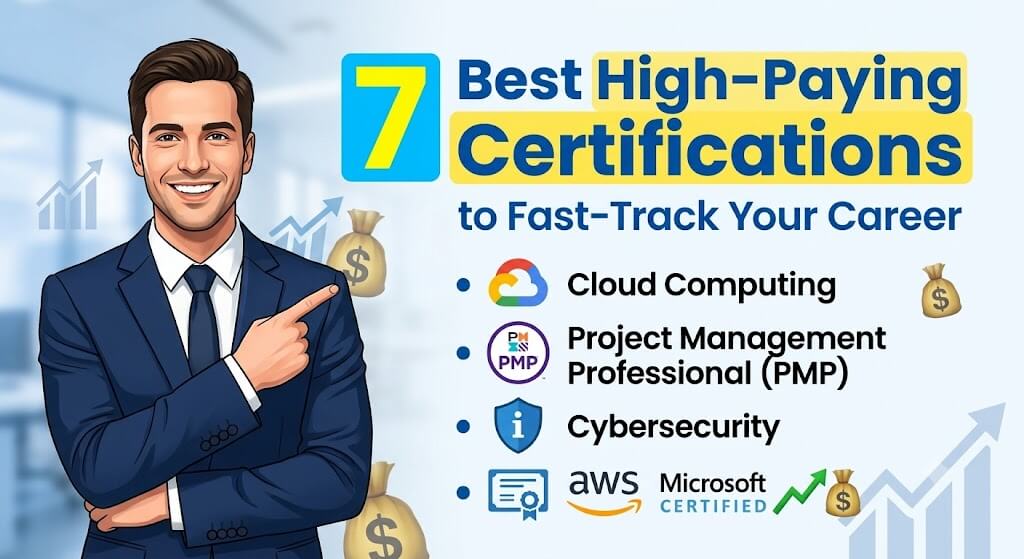
In today’s fast-evolving job market, the traditional four-year university degree is no longer the sole gateway to high-earning potential. A significant shift toward skills-based hiring has led major employers worldwide to prioritize verified technical skills, practical experience, and proven competencies over formal academic diplomas.
Professional certifications provide a structured, cost-effective, and accelerated pathway to validate your expertise. Whether you are aiming to break into cloud engineering, project management, corporate accounting, or cybersecurity, securing high-paying certifications dramatically increases your resume visibility, negotiating power, and overall salary trajectory.
If you are looking to advance your career quickly, exploring the most in-demand high-paying certifications can set you on the fast track to professional success. This detailed guide breaks down seven of the top high-paying certifications available, complete with prerequisites, exam costs, average salary metrics, and strategic career advice to help you select the right qualification for your professional goals.
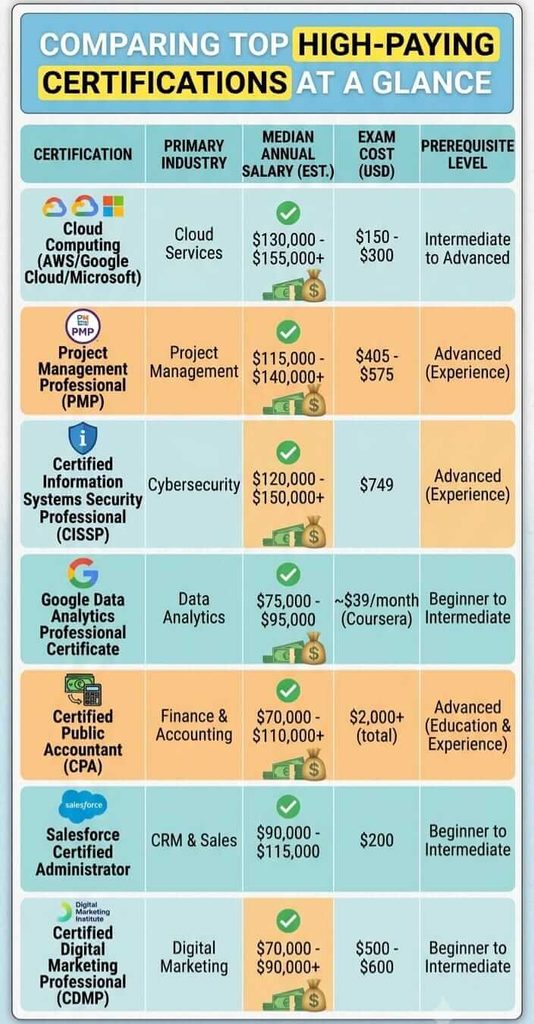
Overview: Top High-Paying Certifications at a Glance
| Certification Name | Primary Industry | Average Annual Salary | Exam Cost | Prerequisites Level |
| AWS Solutions Architect – Associate | Cloud Computing | $130,000 – $155,000 | $150 USD | Intermediate |
| Project Management Professional (PMP) | Business & Management | $115,000 – $140,000 | $405 – $575 USD | Advanced |
| CISSP | Cybersecurity | $140,000 – $165,000 | $749 USD | Advanced |
| Google Data Analytics Certificate | Data Science & Analytics | $75,000 – $95,000 | $39/month (Coursera) | Beginner |
| Certified Public Accountant (CPA) | Finance & Accounting | $90,000 – $125,000 | $1,000 – $1,500 USD | Advanced |
| Salesforce Certified Administrator | CRM & Enterprise Tech | $85,000 – $110,000 | $200 USD | Beginner to Intermediate |
| Certified Digital Marketing Professional | Marketing & E-Commerce | $70,000 – $90,000 | $1,370 USD | Beginner to Intermediate |
In-Depth Breakdown of the Highest-Paying Professional Certifications
1. AWS Certified Solutions Architect – Associate
As enterprise IT architectures migrate to decentralized cloud networks, Amazon Web Services (AWS) continues to maintain the dominant market share in infrastructure-as-a-service (IaaS). The AWS Certified Solutions Architect – Associate credential is widely considered one of the top high-paying certifications for IT professionals, validating your expertise in designing distributed systems, optimizing network performance, and implementing cloud security protocols on AWS platforms.
- Core Competencies Covered: Cloud network architecture, security configurations, multi-tier tenant storage design, cost optimization strategies, and disaster recovery planning.
- Target Roles: Cloud Engineer, Solutions Architect, Systems Administrator, and Enterprise Infrastructure Analyst.
- Prerequisites & Exam Format: While there are no strict official prerequisites, candidates are strongly advised to have at least one year of hands-on experience in cloud deployment. The exam consists of 65 multiple-choice and multiple-response questions administered within a 130-minute timeframe.
- Salary Expectations & Career Impact: According to industry reporting, certified AWS Solutions Architects consistently rank among the top-paid tech professionals, commanding baseline median salaries starting at $130,000 per year. Learn more about official exam details directly on the AWS Certification Official Page.
2. Project Management Professional (PMP)®
Issued by the Project Management Institute (PMI), the PMP qualification is universally accepted as the benchmark standard in project management across IT, construction, manufacturing, healthcare, and corporate finance sectors. It easily ranks among the most valuable high-paying certifications for business leaders, demonstrating an individual’s capacity to lead teams, optimize operational budgets, and deliver projects on schedule.
- Core Competencies Covered: Predictive (waterfall) methodologies, agile project management frameworks, risk mitigation, stakeholder management, and organizational resource allocation.
- Target Roles: Project Manager, Program Manager, Operations Manager, and Scrum Master.
- Prerequisites & Exam Format: PMI enforces strict eligibility criteria. Candidates holding a four-year degree must document 36 months of project leadership experience along with 35 hours of formal project management education. Candidates without a degree must show 60 months of documented leadership experience. The exam contains 180 questions covering predictive, agile, and hybrid methodologies.
- Salary Expectations & Career Impact: PMI’s global earning power report reveals that PMP-credentialed professionals earn up to 20% higher median compensation than non-certified project managers operating within equivalent job roles. Check out our detailed guide on how to build an effective career roadmap to align your project management goals.
3. Certified Information Systems Security Professional (CISSP)
With global enterprise reliance on digital infrastructure growing alongside increasingly sophisticated cyber threats, enterprise cybersecurity has become an essential operational pillar. Granted by (ISC)², the CISSP is regarded as the gold standard for senior cybersecurity roles and remains one of the highest high-paying certifications in global technology sectors.
- Core Competencies Covered: Security and risk management, asset security, security architecture, communication and network security, identity and access management (IAM), and software development security.
- Target Roles: Chief Information Security Officer (CISO), Cybersecurity Engineer, IT Security Manager, and Information Assurance Analyst.
- Prerequisites & Exam Format: Requires a minimum of five years of direct, paid cumulative work experience across at least two of the eight domains defined in the (ISC)² Common Body of Knowledge (CBK). The exam utilizes Computerized Adaptive Testing (CAT) in English, featuring 125 to 175 questions over a 4-hour evaluation window.
- Salary Expectations & Career Impact: CISSP holders frequently breach the $140,000 to $165,000 annual baseline threshold, with executive-track professionals commanding significantly higher enterprise compensation packages.
4. Google Data Analytics Professional Certificate
Designed by Google software leaders and hosted on digital learning platforms such as Coursera, this entry-level option stands out among high-paying certifications because it offers a fast-track pathway into the booming data analytics domain without requiring prior programming experience or specialized mathematical degrees.
- Core Competencies Covered: Structured Query Language (SQL), R programming language, data cleaning methods, data visualization using Tableau, spreadsheet modeling, and ethical data management.
- Target Roles: Junior Data Analyst, Business Intelligence Analyst, Database Administrator, and Operations Research Specialist.
- Prerequisites & Exam Format: Zero prerequisites required. The self-paced learning model involves eight sequential course modules completed via interactive labs, practice quizzes, and a comprehensive capstone project.
- Salary Expectations & Career Impact: Serving as a primary entry point into modern technology careers, graduates typically secure introductory analytics roles offering entry salaries ranging between $75,000 and $95,000 annually.
5. Certified Public Accountant (CPA)
The CPA qualification, administered by individual state boards of accountancy in conjunction with the American Institute of CPAs (AICPA), remains the premier credential within general finance, audit, tax, and corporate accounting management.
- Core Competencies Covered: Auditing and attestation, business environment concepts, financial accounting and reporting, and federal taxation regulations.
- Target Roles: Senior Accountant, Financial Auditor, Corporate Tax Manager, Controller, and Chief Financial Officer (CFO).
- Prerequisites & Exam Format: Applicants generally need a bachelor’s degree in accounting or business administration with 150 total semester hours of college credit. The CPA exam consists of four distinct core components that candidates must pass within an 18-to-30-month rolling window depending on local state board rules.
- Salary Expectations & Career Impact: CPAs earn substantial salary premiums throughout their careers compared to uncredentialed accountants, routinely crossing the six-figure benchmark within three to five years of post-licensure experience. For more insights into finance career paths, read our article on top business skills for modern managers.
6. Salesforce Certified Administrator
Salesforce dominates the worldwide Customer Relationship Management (CRM) software sector. As enterprise organizations continue customizing their customer service, sales, and marketing automation pipelines, certified Salesforce Administrators remain in high operational demand.
- Core Competencies Covered: User configuration management, security controls, custom object customization, workflow automation, report building, dashboard design, and database maintenance.
- Target Roles: Salesforce Administrator, CRM Business Analyst, Systems Specialist, and Enterprise Operations Analyst.
- Prerequisites & Exam Format: No formal mandatory prerequisites. Candidates undergo a 60-question proctored multiple-choice exam spanning 105 minutes, requiring a passing threshold of 65%.
- Salary Expectations & Career Impact: Entry and mid-level certified Salesforce administrators average between $85,000 and $110,000 per year, with consulting specialists earning higher hourly advisory rates. You can explore training modules directly on Salesforce Trailhead.
7. Certified Digital Marketing Professional (CDMP)
The Certified Digital Marketing Professional (CDMP) credential, offered by the Digital Marketing Institute (DMI) and co-validated by the American Marketing Association (AMA), stands as one of the most recognized high-paying certifications in the modern marketing industry. Designed to validate comprehensive expertise across core digital channels, this certification equips professionals with data-driven frameworks to execute scalable campaigns, maximize web conversions, and build strong brand visibility.
For individuals aiming to stand out in a competitive job market, enrolling in top-tier high-paying certifications like the CDMP ensures mastery over both foundational strategies and advanced execution techniques.
- Core Competencies Covered: Search Engine Optimization (SEO), Pay-Per-Click (PPC) advertising, multi-channel content strategy, social media management, automated email marketing, conversion rate optimization (CRO), and Google Analytics performance tracking.
- Target Roles: Digital Marketing Manager, SEO Strategist, Growth Marketer, E-Commerce Specialist, Performance Marketer, and Paid Media Specialist.
- Prerequisites & Exam Format: Open to beginners and seasoned professionals alike. The program includes approximately 30 hours of interactive online coursework followed by a 3-hour proctored examination covering ten essential digital marketing modules.
- Salary Expectations & Career Impact: Holding globally accredited high-paying certifications like the CDMP opens doors to high-growth roles in corporate setups, agencies, and tech startups. Mid-to-senior level digital marketing managers holding this credential routinely command annual salaries ranging from $70,000 to $90,000+, depending on location and enterprise scale.
Academic Degrees vs. Professional Certifications: ROI Analysis
When deciding between pursuing a traditional university degree program or dedicating effort toward specialized high-paying certifications, candidates must evaluate return on investment (ROI), financial commitments, and time horizons.
- University Degree: High Cost ($40k–$100k+) | Long Duration (2–4 Years) | Generalist Knowledge
- High-Paying Certifications: Low Cost ($200–$1,500) | Short Duration (1–6 Months) | Specialized Skills
Key Differences to Consider
- Time Investment: A typical bachelor’s degree requires three to four years of full-time study. In contrast, earning high-paying certifications usually demands between one and six months of focused preparation, allowing candidates to re-skill quickly without pausing their professional careers.
- Financial Commitment: College degree programs frequently incur tuition costs exceeding $40,000 to $100,000, often resulting in long-term student debt burdens. Most certification pathways cost between $200 and $1,500 for study materials and exam fees, offering significantly faster capital payback periods.
- Curriculum Agility: Academic degree curricula can take years to undergo university board reviews, occasionally rendering technical modules outdated by graduation. Professional certifications managed by leading tech organizations undergo continuous updates to align with actual software developments and industry demands.
How to Choose the Right Certification for Your Career
Selecting an appropriate qualification requires a clear assessment of your current technical background, target industry, financial budget, and available study hours.
- Analyze Job Market Demand: Before enrolling in any certification track, audit real-time job listings across platforms like LinkedIn, Indeed, and Glassdoor within your target geographic or remote job market. Take note of credentials explicitly listed under “Required Qualifications” or “Preferred Skills.”
- Match Certifications to Your Experience Level: Taking advanced high-paying certifications like the CISSP without the mandatory five-year work experience history will yield an Associate designation rather than full certification. Complete entry-level certifications (e.g., CompTIA Security+ or AWS Cloud Practitioner) before attempting advanced industry benchmarks.
- Calculate Direct Return on Investment (ROI): Factor in all associated costs, including registration fees, third-party practice exams, boot camps, and renewal cycles, against average regional salary increments. A certification costing $300 that grants access to roles yielding a $15,000 bump in starting salary delivers an exceptional overall return.
Step-by-Step Action Plan to Prepare and Pass Your Certification Exam
Passing industry certification exams on your first attempt requires a disciplined study routine and reliable learning materials. Follow this structured blueprint to ensure exam readiness.
- Phase 1: Review Official Exam Blueprints: Download the official exam guide provided directly by the certifying body (such as PMI, AWS, or ISC²). Review the specific domain weightings to understand which technical sections account for the highest percentage of test questions.
- Phase 2: Combine Theoretical Study with Hands-On Practice: Theoretical reading alone rarely leads to a passing score on modern scenario-based exams. Complement official textbooks and video courses with practical laboratory experience—such as launching free-tier instances on AWS or building custom sandbox environments on Salesforce Trailhead.
- Phase 3: Take Practice Exams Under Timed Conditions: Consistently complete timed practice tests during the final two to three weeks leading up to your scheduled exam. Aim for consistent scores above 85% on full-length mock exams to ensure a comfortable safety margin on test day.
Building a targeted portfolio of recognized high-paying certifications remains one of the fastest, most scalable strategies to enhance your technical authority, land lucrative job offers, and future-proof your career.